
Are You Actually Okay, or Have You Just Become Good at Functioning?

Some days, the proof that you are “okay” is everywhere. The dishes are done. The email was answered. The kids got picked up. The bill was paid before the late fee hit. You smiled at the cashier, replied “good, how are you,” and kept moving.
And still, somewhere under all of that, something in you may be whispering, I am not okay.
That is one of the stranger parts of emotional struggle. Life does not pause just because your inner world feels heavy. Laundry still gathers. Groceries still run out. People still need things from you. So you function. You show up. You do what has to be done.
Then later, when the house is quiet or the car is parked in the driveway, the feelings catch up.
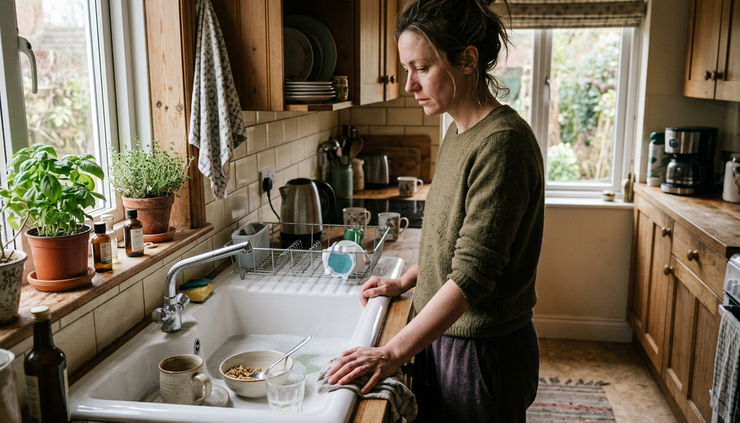
The gap between what gets done and what gets felt
There is a real disconnect between daily responsibilities and true feelings. The outside world often measures coping by results.
Did you go to work?
Did you answer the text?
Did you make dinner?
Did you keep your voice steady?
If the answer is yes, people may assume you are fine. Sometimes you may assume it too, at least for a while. Functioning can become a kind of costume. It helps you get through the day, but it can also hide how much effort the day costs.
I think of the person who gets through a full shift at work, chats normally with coworkers, stops for gas, picks up food, and then sits in the car for ten extra minutes because going inside feels impossible.
Or the parent who reads the bedtime story with warmth in their voice, then cries in the bathroom with the fan on.
Or the student who turns in the assignment on time, but has not felt like themselves in weeks.
None of these people are failing. They are carrying two realities at once. One is visible. One is private.
The pressure to appear fine can be exhausting
Many of us learn early that being “fine” keeps things simpler. It prevents questions. It avoids disappointing people. It keeps us from feeling like a burden.
So we become skilled at small performances.
We say, “I’m just tired.”
We make a joke.
We keep the conversation moving.
We post the normal photo, send the normal emoji, make the normal appointment, and hope no one notices the delay in our voice.
The hard part is that appearing fine can start to feel required. Not just preferred, but required. There may be family expectations, job expectations, financial pressure, caregiving duties, cultural messages, or personal pride wrapped up in the act of holding it together.
And holding it together can be useful. Sometimes it is necessary. A person still needs structure, income, food, connection, and basic routines. But there is a difference between functioning as support and functioning as a hiding place.
When functioning becomes the only acceptable state, there is no room left to be honest.
What would you feel without expectations?
Here is the question that can cut through the noise:
If no expectations existed, how would one genuinely feel?
Not how would you explain it so it sounds reasonable.
Not how would you phrase it so no one worries.
Not how would you soften it to make it easier for someone else to hear.
Just the real answer.
Maybe you would feel sad. Maybe angry. Maybe numb. Maybe relieved to admit that you are exhausted. Maybe you do not know what you feel because you have spent so long responding to what everyone else needs.
That question can be uncomfortable because expectations often shape our emotional vocabulary. If you are expected to be strong, you may call grief “stress.” If you are expected to be grateful, you may call sadness “a bad mood.” If you are expected to have everything under control, you may call overwhelm “being busy.”
But feelings do not disappear because we rename them.
Sometimes the most honest answer is simple: “I would feel tired.” Or “I would feel lost.” Or “I would want to be held without having to explain anything.”
That honesty matters.

Small ways to stop hiding from yourself
Being honest with yourself does not mean you have to tell everyone everything. It does not mean making a dramatic life change by Friday. It can start much smaller.
Try asking yourself one gentle question at a time.
What am I pretending does not hurt?
What part of today took the most energy?
What do I wish someone understood without me having to defend it?
What would I do tonight if rest counted as productive?
Who feels safe enough for a more honest answer?
You can also look for tiny ways to reduce the performance.
Maybe you tell one trusted person, “I’m getting through the day, but I’m not feeling great.”
Maybe you stop saying yes so quickly.
Maybe you let the non-urgent text wait.
Maybe dinner is cereal, leftovers, or whatever takes the least effort.
Maybe you put your phone down and let yourself feel bad for ten minutes without turning it into a problem to solve.
These are not magic fixes. They are small signals to yourself that your inner life counts too.
You are allowed to need care before things fall apart
One of the biggest myths about emotional struggle is that it only deserves attention when everything visibly collapses. But needing care while you are still functioning is valid.
You do not have to be at your breaking point to rest.
You do not have to prove pain by failing at daily life.
You do not have to wait until the mask slips before you ask for support.
If what you are feeling is intense, ongoing, or starting to scare you, reaching out to a therapist, doctor, crisis line, or trusted person can be a real act of care. If you ever feel at risk of harming yourself or someone else, seek immediate help through emergency services or a crisis hotline. You deserve support in that moment, not later.
For the quieter, everyday ache, connection still matters. A simple honest sentence can open a door: “I’ve been functioning, but I haven’t been okay.”
Maybe someone else will answer, “Me too.”
Share what helps you keep going
If this touched something familiar, consider sharing your own experience with functioning while struggling emotionally. What does it look like for you? What helps, even a little? A walk, a playlist, prayer, therapy, journaling, medication, a friend who does not rush you, a pet curled beside you, a clean shower, a day with fewer demands?
Your coping strategy may be the exact thing someone else needs to hear today.
You are more than what you get done. You are allowed to ask what you feel underneath all the expectations. And whatever the answer is, it deserves kindness.


